Which Marketplace Pays Creators the Most After Fees in 2026?
Which marketplace pays creators the most after fees in 2026?
In 2026, Ko-fi pays creators the most after fees — keeping 91-94% of paid income on its free plan and Gold plan respectively. Patreon keeps about 81% after its 10% platform fee plus processing, Gumroad keeps about 79% after 10% + $0.50 per sale plus processing, and Etsy keeps roughly 76-83% depending on region and ad spend. The "best" platform also depends on what you sell, who finds you, and which hidden costs you can avoid.
That headline answer is already more than most platforms will tell you up front. The longer answer is what we're exploring today.
Here's something that might surprise you. When a platform advertises "8% fees," most creators assume that's the whole story. It rarely is.
Think of platform fees like an iceberg. The advertised rate is just the tip; the part they want you to see. By the time your £100 sale actually reaches your bank account, you might be looking at £80-something. Sometimes less. Where does that extra money go?
Let me break this down with a familiar example. Remember buying concert tickets online? The advertised price said £50, but checkout somehow hit £65. Creator platform fees work remarkably similarly. Payment processing, payout fees, currency conversion, premium features - they stack up quietly.
Consider Patreon. They advertise 8-12% fees, yet creators frequently report losing nearly 20% once everything's factored in. Ko-fi promotes itself as 0% commission, which is technically true, until you need their premium features. And Etsy? They've essentially turned fee collection into an art form: listing fees, transaction fees, processing fees, advertising fees. (I sometimes wonder if they've considered a "thinking about selling" fee.)
So how do most creators actually choose their platforms? Interestingly, it's rarely about the mathematics. We tend to pick platforms based on recommendations. Perhaps a creator you admire uses one, or you saw it mentioned in your feed. It's like choosing a restaurant because it looks inviting from the outside, only to discover the prices once you're seated.
The particularly challenging part? You typically discover your real take-home amount after you've already invested time building your presence. At that point, switching platforms feels like moving house. It's technically possible, but exhausting to contemplate.
That's exactly why this comparison exists. Instead of decoding fee structures like ancient puzzles, we're going to look at the actual numbers: advertised rates versus real take-home pay across every major creator marketplace in 2026.
Think of this as your financial GPS for the creator economy. The fees won't disappear, but you'll navigate them with confidence.
Ready to see which platform actually pays creators the most?
Let's dive in.
WHAT THIS GUIDE WILL TEACH YOU
Before we dive into the numbers, let me give you a quick roadmap of what we're covering. Think of this as your checklist. If any of these questions have been nagging at you, you're in the right place.
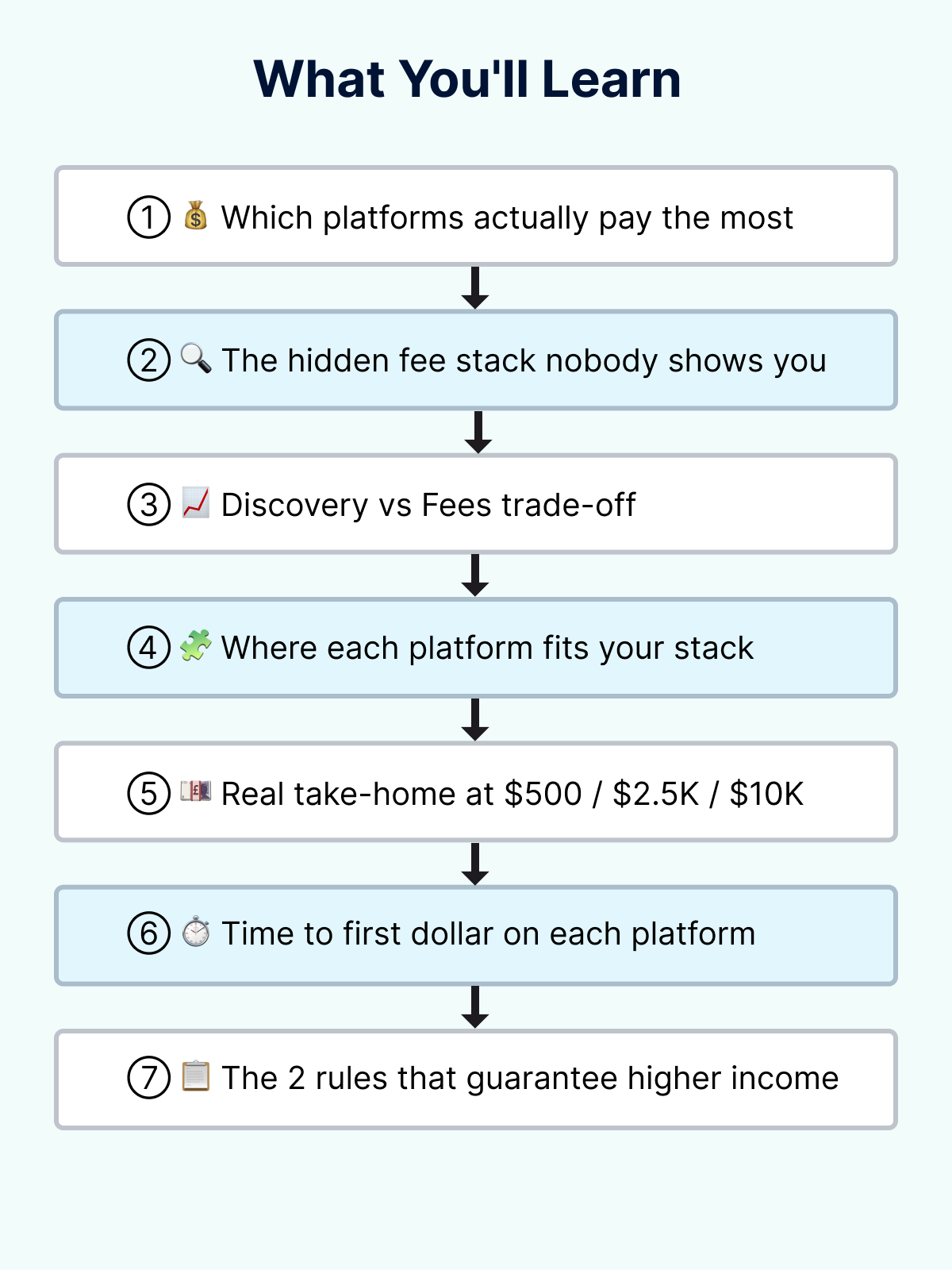
In this guide, you'll learn:
- Which creator platforms actually pay the most after all fees, not just the advertised percentage. We're breaking down platform fees, payment processing, payout fees, currency conversion costs, and (for UK/EU sellers) that sneaky VAT applied on seller fees.
- Exactly how much you'd keep at three realistic earning levels:
→ $500/month
→ $2,500/month
→ $10,000/month
(All based on real calculations, not marketing promises.)
- Why a "high fee" platform can sometimes pay you more per hour than a "0% fee" platform that gives you no discovery, no traffic, and ten times the marketing workload. This one surprises a lot of creators.
- What actually changed in 2025–2026 including falling Medium earnings for many writers, Etsy's VAT-on-fees impact for UK/EU sellers, and TikTok Shop's rising commission structure.
- How different platforms perform for different creator types. Writers, video creators, digital product sellers, visual artists, and 3D creators all have different optimal platforms. We'll help you find yours.
- The true cost of switching platforms migration time, lost marketplace discovery, expected audience drop-off, and how long it really takes to break even. (It's not as scary as it sounds, but it's not nothing either.)
- A simple framework for choosing the right platform based on your goals, your product type, your energy levels, and whether you already have an audience.
- How to calculate your own "effective hourly rate" so you can spot which platforms are quietly wasting your time and which ones are actually profitable.
- Why most successful creators stack platforms (YouTube + Patreon + Gumroad, Etsy + Shopify, Medium → Substack/Beehiiv) and how to design a platform stack that actually works for you.
That's a lot of ground to cover. But here's the thing: you don't need to read every section. Use the table of contents to jump to the platforms and creator types that matter most to you.
Ready? Let's start with the numbers everyone wants to know.
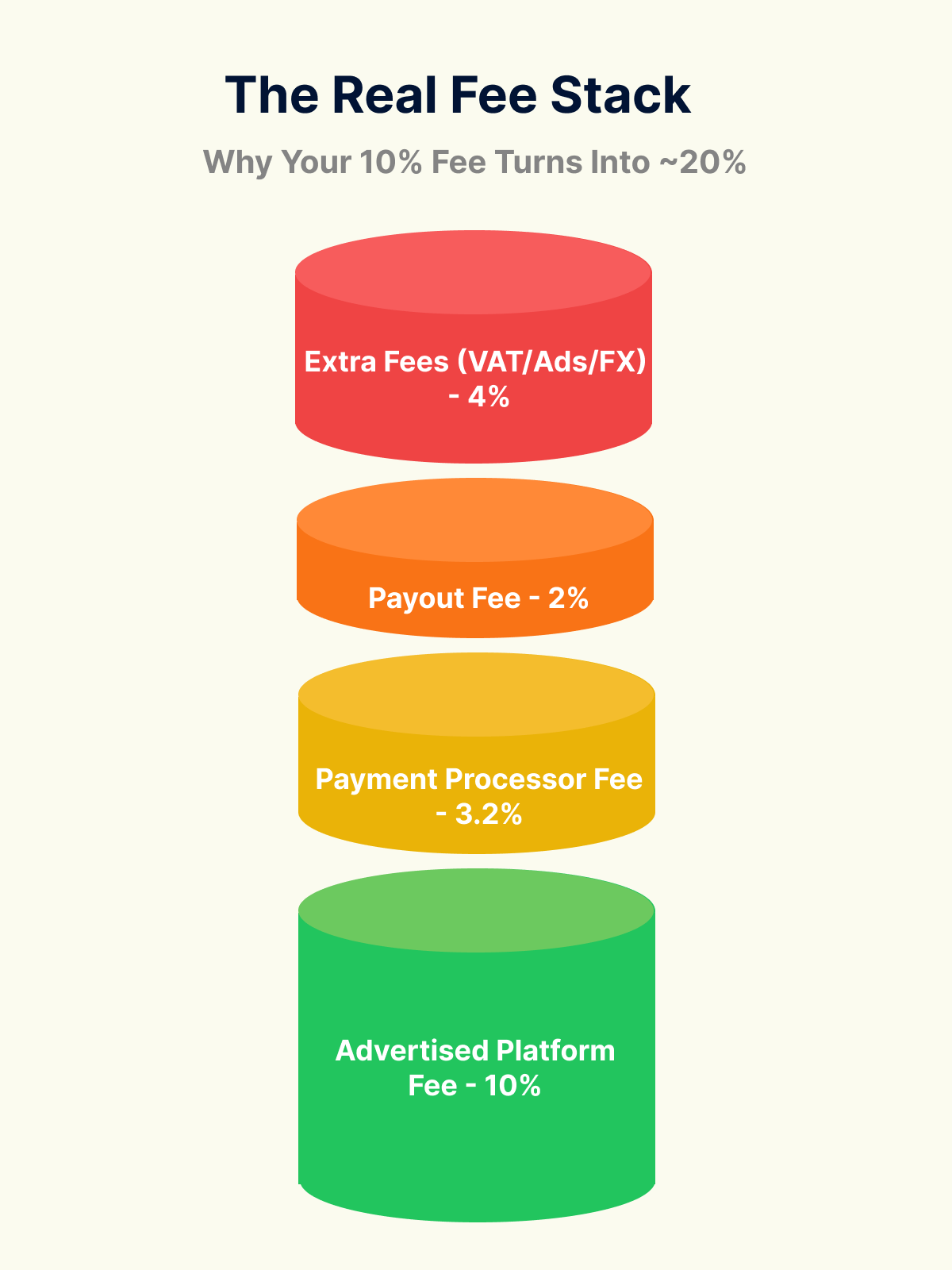
Ever looked at your payout and thought, "Wait... where did my money actually go?"
This is where it went. Every single layer.
And here's the thing: most creators don't see this full picture until they've already committed to a platform. So in the next section, we're going to unpack exactly how each layer quietly eats into your income. No more surprises.
SECTION 1: THE BIG PROBLEM: Why Most Creators Have No Idea What They Actually Earn
Here's the uncomfortable truth that took me way too long to accept:
Most creators have absolutely no idea what they're actually taking home.
Not because they're careless. Not because they "don't understand fees." It's because the internet genuinely makes it impossible to know, unless you sit down with a calculator, a spreadsheet, three cups of coffee, and the emotional resilience of a Victorian chimney sweep.
Every creator platform advertises one clean number. Reality is ten layers deeper.
Let's break down why this happens and why creators get blindsided every single day.
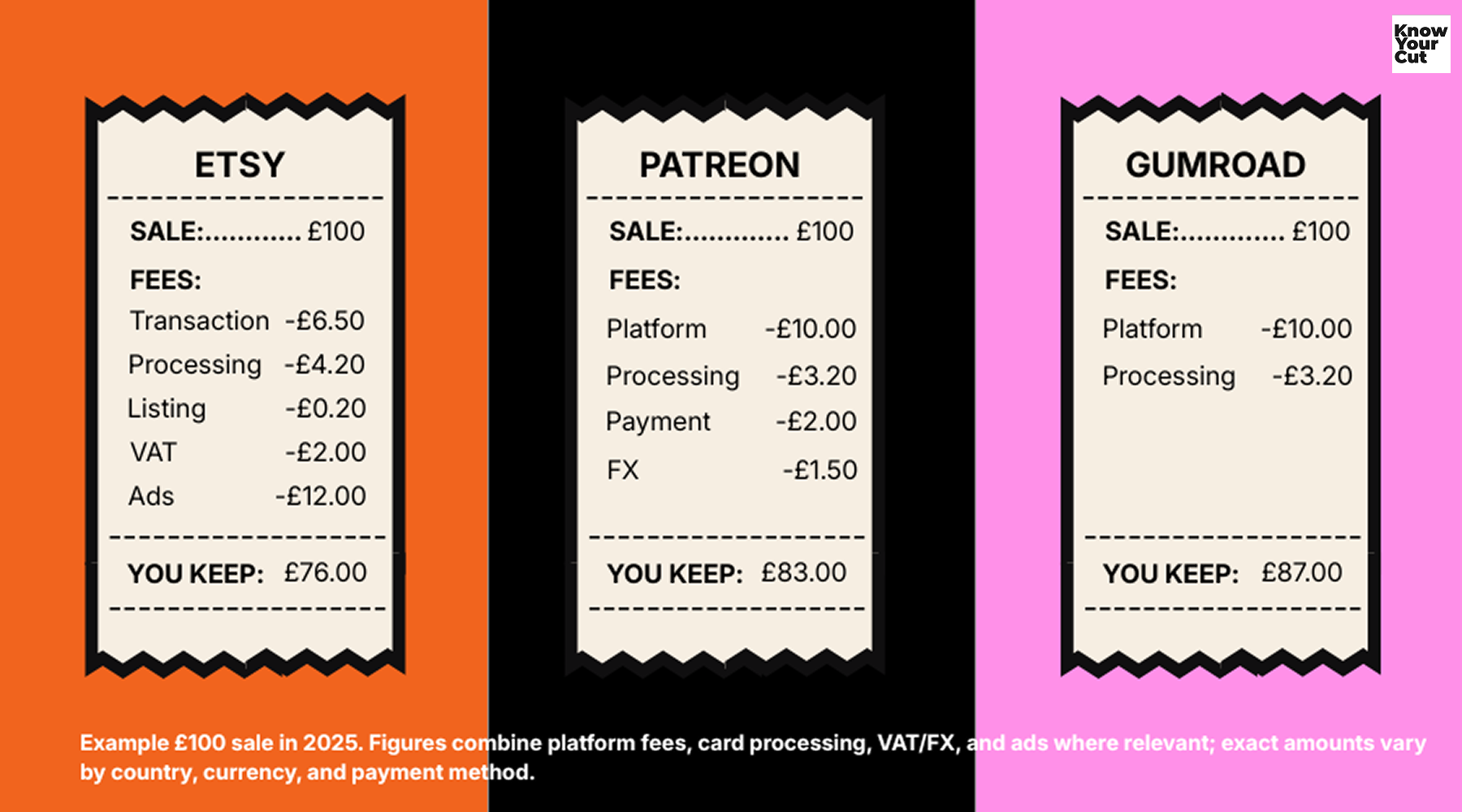
The Fee-Stack Illusion
Every platform tells you the same adorable bedtime story: "We only take X%!"
Cute. Here's what actually happens under the hood:
- Platform fee
- Payment processing fee (Stripe/PayPal — usually 2.9% + $0.30)
- Payout or withdrawal fee (yes, you get charged to access your own money)
- Cross-border or currency conversion fee (typically 1–3%)
- VAT on platform fees (UK/EU creators know this pain intimately)
- Subscription fees (Ko-fi Gold, Shopify Basic, Patreon Pro/Custom plans)
- Platform-specific extras (Etsy listing fees, Offsite Ads, hosting, "boosts," and so on)
It's like ordering a £3 coffee and somehow ending up with a £19 tab because someone added "service," "cup," "air," and a "gravity surcharge."
This is why creators think they're losing 8%... but actually end up losing 15–25% once everything stacks together.
And that's before we even talk about the real killer: time.
Income Level Changes Everything
Here's the worst part: the smaller you are, the more the system punishes you.
At $100/month as a creator:
- Stripe's $0.30 fixed fee feels like a personal attack
- Etsy's $0.20 listing fee suddenly feels like a luxury tax
- Patreon's payout fees eat a meaningful slice of every tiny deposit
- VAT-on-fees inflates everything for UK/EU sellers
- Conversion fees nibble at whatever's left
A £1–£3 sale with a $0.30 fixed fee? That's not a fee, that's a structural disadvantage.
At $10,000/month:
- Fees go up in absolute dollars
- But they shrink as a percentage of revenue
- Fixed fees become irrelevant
- Payout fees stop stinging
- VAT-on-fees becomes an irritation, not a crisis
Low-volume creators are fee roadkill.
High-volume creators get mildly annoyed.
And honestly? No platform ever explains this. It should probably be a crime.
Discovery vs No-Discovery: The Real Hidden Cost
This is the part blogs, YouTubers, or even the platforms themselves, don't talk about.
Sometimes the platform with higher fees actually pays you more per hour.
Sounds impossible, right? Until you look at the math.
Platforms with discovery (Etsy, Medium, YouTube)
These bring traffic to you. You show up in search. You get recommended. You can make sales while you sleep.
Time investment: 5–10 hours per week creating, plus 2–5 hours on admin and maintenance.
Platforms without discovery (Gumroad, Ghost, Substack)
You get nothing unless you bring your own audience. No meaningful search. No algorithmic distribution. No built-in demand.
(Yes, Substack has a recommendation network. Yes, Gumroad technically has "Discover." But most creators still describe the experience as: "I'm on my own.")
Time investment: 15–25 hours per week marketing, posting, promoting, emailing, tweeting, and occasionally begging. Plus creating the actual content.
So your options become:
Lose 14% on Etsy... but spend 30 fewer hours on marketing. Get free traffic from search, SEO, and marketplace dynamics.
Or lose 3–8% on Gumroad... but spend 80 hours posting TikToks hoping one person buys your £7 ebook.
Which one actually pays better per hour?
Exactly.
This is where effective hourly rate becomes the metric that truly matters and where most fee calculators fall apart.
The Algorithm Problem
Some platforms do have built-in traffic. But it comes with strings attached that nobody explains up front.
Here's what creators actually report:
- "After joining TikTok's Creator Marketplace, it felt like my reach dropped unless I accepted brand deals."
- "Instagram's Creator Marketplace is basically crickets. Hardly any solid offers."
- "Medium used to pay well... now writers say earnings per 1,000 views are dramatically lower in 2025–2026 than in earlier years."
None of these are official policies. They're the lived reality creators talk about in forums, Discord servers, and frustrated Twitter threads.
And here's the deeper issue: algorithm volatility is a hidden fee in disguise.
You're paying with your visibility.
You're paying with your consistency.
You're paying with your sanity.
None of this shows up in the neat little percentage on the pricing page. But it costs you all the same.
The 2025–2026 Fee Changes That Blindsided Everyone
Before we get into individual platform breakdowns, here's a quick overview of what changed recently and why all those 2024 comparison posts are officially out of date.
Medium earning power dropped.
Many writers report earning 40–60% less per 1,000 views than they did in 2022–2023.
TikTok Shop commissions climbed.
Multiple regions moved toward 8%+ seller fees.
Etsy introduced VAT on seller fees.
UK/EU creators now pay VAT on listing, transaction, and payment processing fees.
Patreon's "effective fee" discourse exploded.
The advertised total deduction is 8-12% but creators breaking down their total deductions often land somewhere around 15–20%.
Stripe's fee structure continues to punish small transactions.
That $0.30 fixed fee makes low-priced items disproportionately expensive to process.
If you're reading fee advice from 2024 and assuming it still applies today, it doesn't.
The economics of being a creator are shifting. Fast. And quietly.
All of This Leads to One Truth
The platform with the lowest "fee percentage" is not automatically the platform that pays you the most.
Not per sale.
Not per month.
And definitely not per hour of your life.
This is the part all the comparison charts miss.
Which is exactly why the next sections dive into real numbers, real fee stacks, real creator experiences, 2025–2026 changes, and actual "you-keep-this-much" breakdowns so you can finally see which platforms are worth your time and which ones only look cheap on paper.
Because guessing isn't a business model. Clarity is.
GUMROAD
The short version:
Gumroad is simple, clean, and great for selling digital products. But it has almost no discovery. There's technically a "Discover" marketplace, but most creators say it brings virtually no reliable traffic. Assume you're driving every single sale yourself.
Who it's for:
Digital product creators who want simplicity and who already have an audience or the stamina to build one from scratch.
Discovery: Minimal
Yes, there's a Discover section. No, it rarely moves the needle. There's no meaningful algorithm or reliable marketplace reach, nor search-driven demand. Expect to bring your own traffic. If you're hoping Gumroad will help people find you, you'll be waiting a long time.
Time to first sale:
Entirely dependent on your existing audience. Could be hours if you've got a newsletter list ready to buy. Could be months if you're starting from zero. Gumroad does not send traffic your way.
What they advertise:
10% plus $0.50 per transaction on direct sales through your profile. If a sale comes through Gumroad Discover, fees jump significantly, often around 30% once processing is included.
What you actually pay in 2026:
The reality is more layered than the advertised rate suggests. You're looking at the 10% platform fee plus that $0.50 fixed charge, then payment processing adds another 2.9–3.5% plus $0.30–$0.49 depending on your region. There's no monthly subscription, which is genuinely nice. But payout costs vary by method. For example, PayPal withdrawals can add their own fees on top.
Here's where it stings: because of those fixed fees ($0.50 plus the $0.30 processing charge), small-ticket items in the $5–$10 range can see effective fees of 17–25%. Yes, really. That £7 ebook you're selling? You might be keeping less than £5.50.
What changed in 2025–2026:
Structurally, Gumroad remains simple. But its discovery disadvantage is now even more obvious as competitors like Stan, Lemon Squeezy, Payhip, and Shopify push harder into the creator space with better tools and more aggressive marketing.
What creators actually say:
The frustrations tend to follow a pattern. "Feels like shouting into the void." "Love the simplicity, hate the zero traffic." And my personal favourite: "Discover didn't discover me."
The contrarian take:
If you sell high-ticket digital products like courses, templates, software, Gumroad's percentage fees matter far less. A 10% cut on a $200 product is manageable. But the time cost of driving all your own traffic? That matters more than ever. You're not paying with money; you're paying with hours.
Bottom line:
Gumroad is perfect if you already have demand. It's not the place to go if you're relying on the platform to create that demand for you.
[Full platform breakdowns for Patreon, Ko-fi, Substack, Medium, Etsy, Shopify, YouTube, TikTok, Beehiiv, CGTrader, TurboSquid, Unity Asset Store, and Fab continue in the full article...]
CHECK YOUR REAL TAKE-HOME
This guide gives you the big picture: the thinking, the strategy, the hidden fees, the time cost, the 2025–2026 changes that blindsided everyone.
But your actual take-home depends on your specific situation. Your country. Your product price. Your platform combination. Your audience size. Your payout method. Your currency. No blog post will ever be as accurate as running your exact numbers through a tool built specifically for this calculation.
So when you're ready to stop guessing, see exactly how much you would earn after every fee. Run your product through KnowYourCut — the platform fee calculator for creators.
No login. No email required. No fluff. Just: "If I earn X on Platform Y, here's what I actually take home."
Perfect for comparing Etsy versus Shopify, Substack versus Beehiiv, Patreon versus Ko-fi, Gumroad versus marketplaces, Unity versus CGTrader versus Fab, YouTube versus TikTok earnings, or any platform stack you're considering.
This is the tool thousands of creators secretly wish existed. Now it does.
Related Reading
- Etsy Fees Explained 2026 — full Etsy fee breakdown by region
- Gumroad Fees Explained 2026 — complete Gumroad fee guide
- Ko-fi Fees Explained 2026 — Ko-fi Free vs Gold breakdown
- Patreon Fees Explained 2026 — Patreon's fee structure with worked examples
- Substack Fees Explained 2026 — what Substack's 10% really costs
{{faq}}
[
{
"question": "Which creator platform pays the most after all fees?",
"answer": "It depends on what you sell, your audience size, and discovery needs. Beehiiv offers the highest take-home per subscriber (0% platform fee). CGTrader provides up to 90% royalties for 3D sellers. Gumroad has clean fee structure for digital products. YouTube delivers the highest earnings for video creators even with 45% cut. Shopify becomes cheapest above ~$850/month. Etsy has high fees but unbeatable discovery."
},
{
"question": "Why did my Medium earnings collapse in 2025–2026?",
"answer": "Medium's Partner Program payouts dropped to roughly $0.80 per 1,000 impressions, down from $3–$5 in 2022-2023. Writers who earned $300–$800/month are now reporting $80–$160. Medium still has excellent discovery but poor earnings. Treat it as a funnel to your own platform, not as your income source."
},
{
"question": "Is Beehiiv really 0% fees? What's the catch?",
"answer": "Beehiiv truly charges 0% platform fees on paid subscriptions. The only fees are Stripe's 2.9% + $0.30 per transaction, and optional paid Beehiiv plans ($42–$84/month) for advanced features. The catch? Beehiiv has less built-in discovery than Substack, so you need to bring or grow your own audience."
},
{
"question": "Why is Patreon's fee always higher than advertised?",
"answer": "Patreon's real cost includes the platform fee (8–12% for legacy, 10% for new creators), plus payment processing (~2.9% + $0.30), plus payout fees (1–3%), plus currency conversion (1–2%). This is why creators report the '20% disappearing act' – it's the reality of stacked fees."
},
{
"question": "Should I sell digital products on Etsy or Gumroad?",
"answer": "If you need traffic, Etsy. You'll make sales quickly even with no audience, but pay 20–30% in stacked fees. If you want clean payouts, Gumroad offers higher margins but zero meaningful discovery. The hybrid strategy works best: start on Etsy to validate, then migrate winners to Gumroad or Shopify."
},
{
"question": "When should I switch platforms?",
"answer": "Switch only if you earn more than ~$850/month (Shopify becomes cheaper than Etsy), you're losing meaningful money on percentage fees, you want to own your audience data, your current platform is capping growth, or your effective hourly rate is collapsing. Common trigger: when Etsy fees exceed $300/month."
}
]